Artificial intelligence is quietly reshaping football recruitment, changing how clubs discover talent, analyse performance, and make transfer decisions with far greater precision.
I still remember sitting with a friend who works in scouting a few years ago, and he said something that stuck with me: “Football isn’t just watched anymore, it’s computed.” At the time, I thought he was exaggerating. But now, after seeing how deeply data has entered the game, I realise he wasn’t wrong at all. The rise of how football clubs use artificial intelligence for recruitment has completely changed how players are discovered, analysed, and signed.
And honestly, it’s fascinating.
Today, clubs aren’t just relying on scouts with notepads in stadiums. They’re combining human judgment with algorithms that process millions of data points in seconds. It’s like football has gained a second brain.
When I First Realised AI Had Entered Football
I had a moment of clarity watching a lower-league match online. A young midfielder, unknown to most fans, was being tracked not just by scouts in the stands, but by software analysing his every touch in real time.
That’s when I truly understood how football clubs use artificial intelligence for recruitment. It’s not science fiction anymore, it’s everyday football operations.
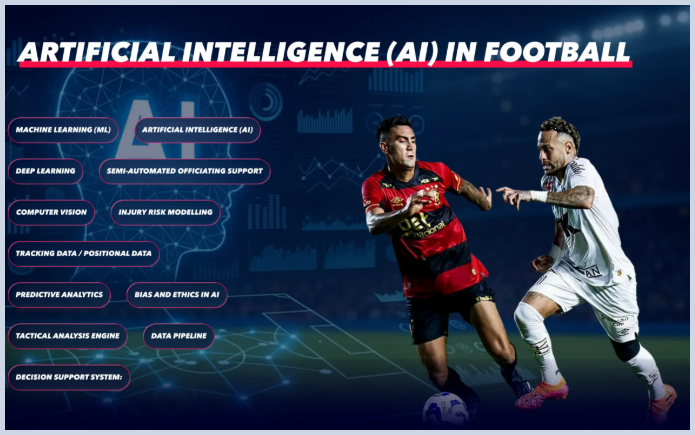
Clubs now use AI systems to evaluate:
- Passing accuracy under pressure
- Movement off the ball
- Defensive positioning patterns
- Fatigue levels during matches
- Injury risk probability
Instead of watching full matches repeatedly, analysts can now focus on highlights generated by AI models.
Data Over Gut Feeling (But Not Completely)
One thing people often misunderstand is that AI hasn’t replaced scouts. It has enhanced them.
Traditional scouting still matters, especially for personality, mentality, and adaptability. But AI helps narrow the pool. It filters thousands of players down to a manageable shortlist.
When people talk about how football clubs use artificial intelligence for recruitment, this balance is key: machines analyse patterns, humans interpret character.
A scout once told me, “AI finds the needle in the haystack. We decide if it’s worth picking up.”
That line stuck with me.
The Algorithms Behind Player Discovery
Modern clubs use machine learning models that compare players across leagues, even when competition levels differ drastically.
For example, a winger in a smaller league might not have huge exposure, but AI can compare his metrics to Premier League standards by normalizing data. Suddenly, hidden gems become visible.
These systems analyse:
- Expected goals (xG) contribution
- Pressing intensity
- Progressive carries
- Decision-making speed
- Spatial awareness
This is where using artificial intelligence for recruitment becomes incredibly powerful. It removes bias based on league popularity or reputation.
A Personal Insight: Watching Recruitment Change
A few years ago, I visited a club training facility during a media session. I noticed screens filled with heat maps, player clusters, and real-time performance graphs. It didn’t feel like football anymore, it felt like a tech startup.
One analyst explained how they could simulate a player’s impact before signing him. They even ran scenarios like: “What happens to our midfield structure if this player replaces our current starter?”
That level of detail blew my mind.
It made me realise recruitment is no longer just about talent, it’s about fit, balance, and predictive performance.
AI and Transfer Market Strategy
Another major advantage of AI in recruitment is financial efficiency.
Clubs can now avoid expensive mistakes by identifying undervalued players early. Instead of paying inflated prices for established stars, they target emerging talent before the market catches up.
This approach has reshaped transfer strategies across Europe. It’s no longer unusual for clubs to sign relatively unknown players who later become stars.
And again, this is a direct result of how football clubs use artificial intelligence for recruitment in scouting departments worldwide.
Injury Prediction and Risk Control
One of the most underrated uses of AI is injury prevention.
By analysing movement patterns, workload data, and physical strain, AI systems can predict injury risks before they happen. Clubs use this to decide whether a player is worth signing or even whether to rest him during congested fixtures.
This alone saves millions in potential transfer losses and medical costs.
Does AI Take Away Football’s Romance?
Sometimes I ask myself this question.
There’s something magical about a scout discovering a player in a remote stadium, watching him once, and saying, “He’s the one.” Can an algorithm replicate that feeling?
Maybe not emotionally, but it can support it.
At the end of the day, football still belongs to human instinct. AI simply makes that instinct sharper.
Conclusion
The evolution of how football clubs use artificial intelligence for recruitment shows how modern football is blending tradition with technology. Clubs are no longer just competing on the pitch, they’re competing in data rooms, analysis hubs, and algorithm-driven scouting systems.
From my perspective, AI hasn’t taken the soul out of recruitment. Instead, it has added a new layer of intelligence to it.
And if anything, the future will only deepen this relationship between human insight and machine precision.